
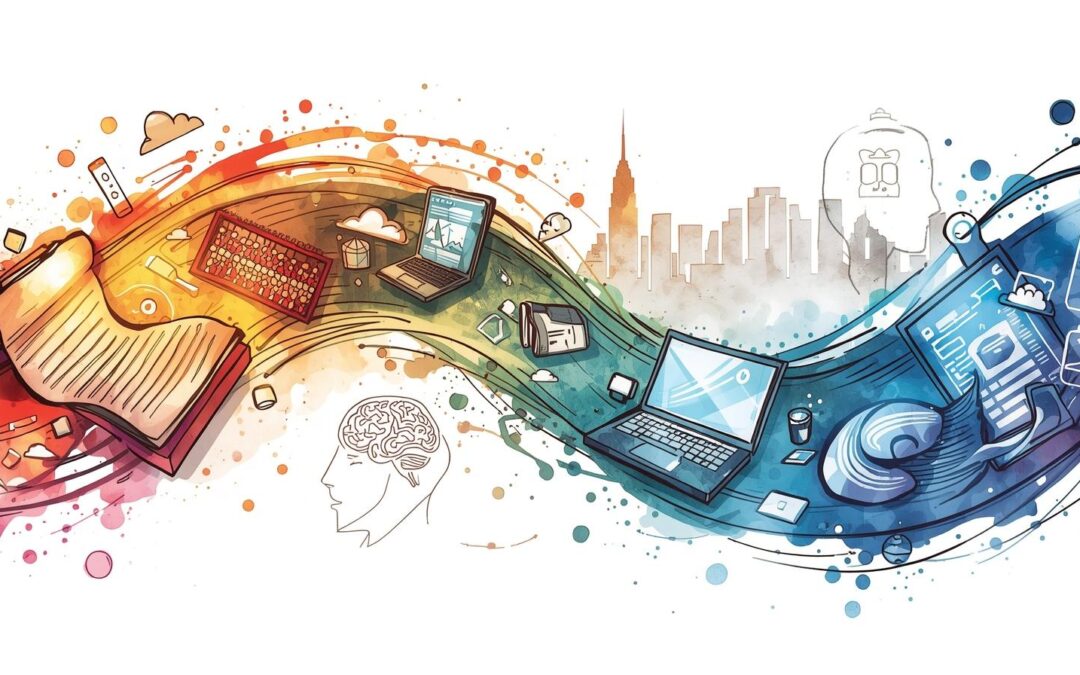
Organised Knowledge, Inherited Wisdom, and Predictive Development
We are living through a profound transformation—the digital age. This era is defined by the exponential capacity to organise, inherit, and utilise vast stores of information and knowledge from the past, enabling us to build sophisticated models to predict and pursue achievable future development. This global shift impacts every field, from ancient wisdom traditions to modern finance and infrastructure.
✍️ Inheriting the Past: From Hand-Written Records to Digital Base Data
The true scope of the digital age is best understood by looking at the entire history of information organisation. Before the cloud and even before the first computer, knowledge was organised through laborious physical processes.
The Pre-Digital Legacy
Knowledge inheritance relied entirely on tangible methods, creating a foundational challenge of scale and accessibility:
-
Manual Handwritten Era (Before Typewriters): Records were meticulously created through manual handwritten documents on scrolls, ledgers, or stone tablets. This knowledge was slow to create, difficult to copy, prone to decay, and its organisation depended entirely on the physical system (e.g., library classification, scroll cabinets). Retrieval was an arduous, physical task.
-
Typewriter and Hardcopy Era: The invention of the typewriter introduced standardisation and speed to documentation, resulting in the proliferation of hardcopy files, reports, and books. While faster to produce than handwritten text, the data remained physically bound, requiring massive file rooms and relying on manual indices.
The IT Evolution: Organising Information for Predictive Use
The digital journey is one of continually enhancing organisation, accessibility, and speed, moving data from chaotic, localised storage to dynamic, networked intelligence:
| Era | Key Technology | Organisation Principle | Impact on Knowledge Access |
| Early Digital | MS Word / Excel (Local Files) | Structured Files, Local Storage | Standardised documents, improved search, limited sharing. |
| Internet Era | Email, Websites | Distributed Access, Networked | Global sharing, vast unstructured data, reliance on fixed lines. |
| Cloud Drive | ERP Systems, Cloud Storage | Centralised/Shared Storage, Real-Time Sync | Enhanced collaboration, data security, remote access. |
| Base Data & AI | Big Data, 5G, AI/ML | Organised Data Lakes, Algorithmic Prediction | Real-time analysis, automated forecasting, knowledge generation. |
This evolution necessitates the rigorous process of digitalisation and scanning of hardcopy for legacy documents, and the use of digital e-invoicing for new transactions. All information must be housed within a secure, organised cloud infrastructure. This ensures that all historical data—from ancient scrolls to modern financial statements—is captured as clean, structured information.
Data Storage with Future Retrieval in Mind
The power of the digital age is realised only when information is stored with the intention of future retrieval by sophisticated systems, particularly AI systems. This requires transforming the raw input:
- Standardisation: Implementing consistent data structures, formats, and terminologies across all documents.
- Contextual Tagging: Attaching metadata (tags, timestamps, relationships) to raw data to provide context.
- Cleanliness: Continuous data validation and cleansing to ensure the information fed to AI is accurate and unbiased.
This rigorous organisation transforms chaotic historical records into a reliable knowledge inheritance system, allowing AI to rapidly retrieve and process information to generate powerful insights.
☯️ Inherited Knowledge: Organising Time and Space
The human impulse to organise complex information for prediction is an enduring cultural heritage. Ancient Chinese systems offer historical precedents for strategic organisation that are now amplified by digital tools.
-
Feng Shui (風水): The Organisation of Space. This tradition provides a complex framework for optimising physical environments for energy and harmony. Digitally, this translates to optimising digital architecture, workflow systems, and user experience design to ensure optimal flow and productivity within a networked environment.
-
Qimen Dunjia (奇門遁甲): The Organisation of Time and Strategy. This ancient system is a masterclass in organised, predictive forecasting, relying on complex charts that map time and directional influences to identify the most opportune moment for action. Digital tools now generate and interpret these charts instantaneously, allowing modern strategists to quickly evaluate the optimal timing for critical decisions, complementing quantitative models with ancient wisdom.
These systems illustrate that knowledge inherited from the past is a highly organised, structured resource that remains relevant when integrated with modern computational power.
📈 Predicting Achievable Development: Finance and Infrastructure
The most tangible impact of this organised digital knowledge is seen in the capacity to monitor and predict global systems, especially finance and communication.
-
Advanced Quantitative Techniques: The wealth of clean, organised data allows for the application of advanced Quantitative Techniques (like those used in professional financial analysis) across diverse fields. Machine learning models, trained on this historical and real-time data, can provide precise predictive forecasting for economic trends, resource demands, and market shifts, replacing intuition with statistical certainty.
-
Capital Market Monitoring and Accessibility: The ability to monitor global capital markets in real-time, leveraging low-latency data, enables instantaneous trade execution and proactive risk management that was technologically impossible two decades ago. Crucially, the deployment of 5G technology has made this high-speed, organised data access available in rural areas, eliminating the reliance on fixed-line internet. This democratises access to sophisticated financial and operational data, enabling businesses and communities in previously isolated regions to participate in data-driven global development.
🎯 Conclusion: The Future of Organised Knowledge
We live in the age of organised digital inheritance. By diligently collecting and structuring data from our past—whether it’s the manual handwritten records of centuries ago or the latest digital e-invoice—we create the necessary knowledge base. This base, enhanced by AI and distributed via high-speed 5G infrastructure, empowers us to achieve unprecedented transparency and clarity in our systems. The ultimate outcome is the capacity to move beyond simply recording history, and instead, to confidently predict and pursue achievable future development built on the most comprehensive and organised knowledge system ever devised.


